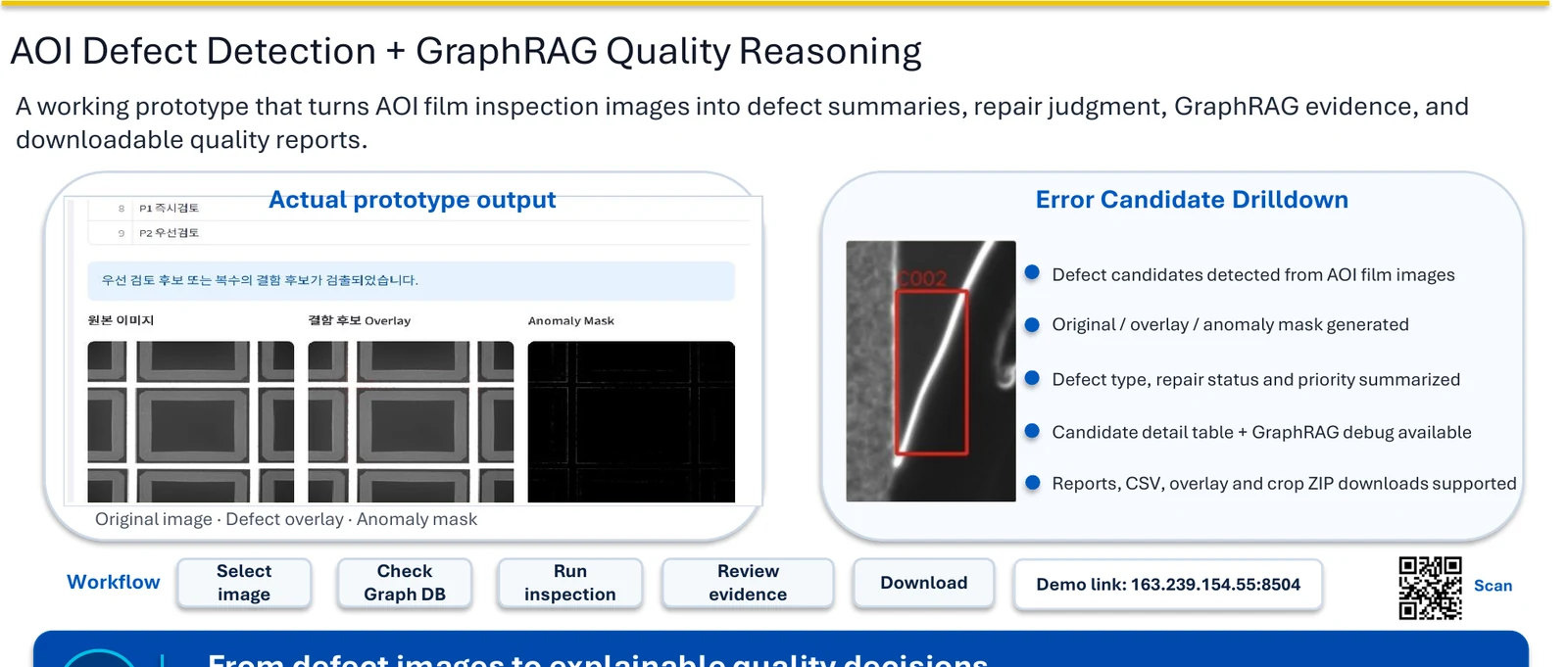
Inspection Evidence Workspace
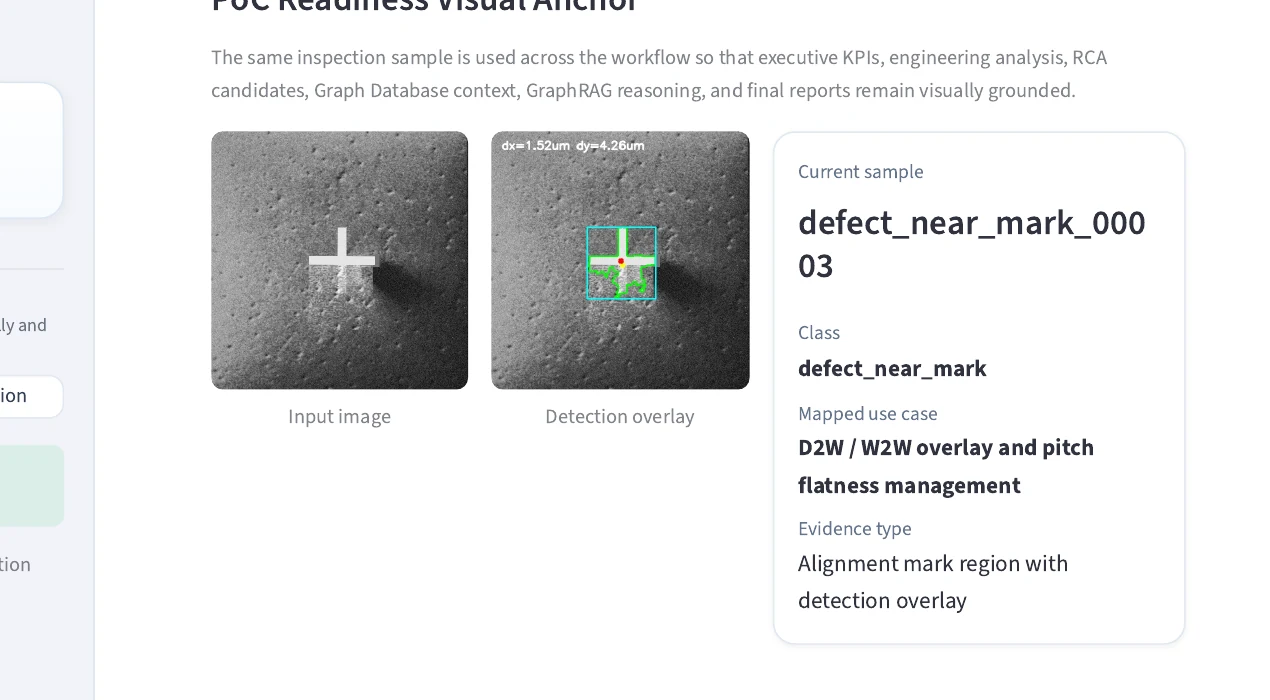
Review inspection images and decisions together with lot, material, and process-condition context.
Enterprise GraphRAG connects enterprise knowledge and relationships; Evidence Assurance verifies the claims, citations, evidence, and provenance behind AI answers. Industrial AI extends the same intelligence principles to engineering decisions grounded in field and physics context.


Public demos use anonymized or synthetic data. Customer-environment performance is validated separately through a PoC
Semantic Graph moves beyond displaying detections by connecting manufacturing context, evidence, similar cases, and corrective-action history.
Review inspection images and decisions together with lot, material, and process-condition context.
Review ranked root-cause candidates together with the manufacturing records that support each conclusion.
Support the next engineering decision with standards, historical defects, action records, and similar cases.
These are representative interface modules for explaining the product workflow. Detailed capabilities and customer-specific scenarios are provided after an implementation inquiry.
When inspection results are disconnected from lot, process, equipment, material, and corrective-action history, root-cause analysis and recurrence prevention become difficult

Detection results need to be connected to process context and evidence
Images, lots, equipment, materials, and process conditions need a shared context
Past defects and corrective actions should become reusable operational knowledge
Design conditions, temperature fields, numerical results, and evidence need to be linked for case search, comparison, and traceability
Both solution areas share one intelligence model: connect data, understand context, verify evidence, and keep results, conditions, and history traceable. Physics AI prediction is a follow-on stage when customer data and reference results support independent validation
Bring together documents, databases, policies, images, sensors, lots, and process data around the workflow that matters
Document · Data · Vision · Sensor · ProcessUse ontologies and knowledge graphs to structure relationships across concepts, equipment, processes, and historical cases
Ontology · Knowledge Graph · Hybrid Retrieval · RCAEnterprise Knowledge AI verifies evidence and citations; Industrial AI connects results and context through vision and knowledge graphs. Physics AI prediction remains a separately validated follow-on capability
Evidence Assurance · AI Vision · Knowledge Graph · Physics AI RoadmapKeep answers, analysis, predictions, and supporting evidence together so people can review the result and decide what to do next
Traceability · Human Review · Decision Support · On-PremThis page explains how we structure the problem and solution. For working screens, current versions, validation status, and Demo/PoC scope, use Products & Demos.
Connect enterprise documents, data, and business rules; verify which evidence supports each AI answer; and measure current RAG quality before deciding what to improve.
Connect vision, sensor, process, and thermal-analysis outputs with lots, equipment, design conditions, prior cases, and evidence so isolated results become reusable engineering intelligence.
Provide the data, sources, and operating context behind each output
Show which data and sources support each result, answer, and engineering decision
Connect inspection and enterprise knowledge to the relevant lot, process, document, and relationship context
Separate demos from field validation and verify PoC goals and KPIs with customer data
PoC scope is defined around each domain’s data, workflow, security requirements, and decision context
Connect HBM and advanced-packaging thermal-analysis results, design conditions, and validation evidence for condition comparison and design-change traceability. Initial users include thermal engineers, CAE teams, and semiconductor R&D groups.
Connect inspection images with lot, process, and equipment history to analyze defect patterns and root causes, supporting RCA, quality improvement, and process decisions.
Connect policies, operating guidance, audit, risk, and regulatory content through a knowledge graph to validate clause discovery, evidence-grounded Q&A, and source traceability.
Align mission, asset, logistics, and policy knowledge through a Defense Ontology to explore semantic interoperability, knowledge discovery, and Agentic AI foundations.
Semiconductor and Manufacturing are current focus areas. Financial Knowledge AI is being explored as a proposed Risk & Compliance GraphRAG PoC use case for financial services, while Defense remains a research and application area
Infrastructure, AI assurance, and enablement for PoC, on-premises deployment, and operation
Configure GPU servers, on-premises LLMs, GraphRAG, and AI platforms for the customer environment
Discuss Adoption →Structure domain concepts, relationships, rules, and provenance into a knowledge layer that supports Enterprise GraphRAG and industry-specific Knowledge AI
Discuss Implementation →Deliver enterprise and research training in Physical AI, GraphRAG, PINN (Physics-Informed Neural Network), and Thermal Engineering Knowledge Twin
View education programs →Enterprise Knowledge AI and Industrial AI both start small. Clarify the problem and data context, validate evidence and KPIs on customer data, then define the systems, security, and on-premises scope needed for operations
Define the business or engineering problem, data types, current workflow, and success criteria
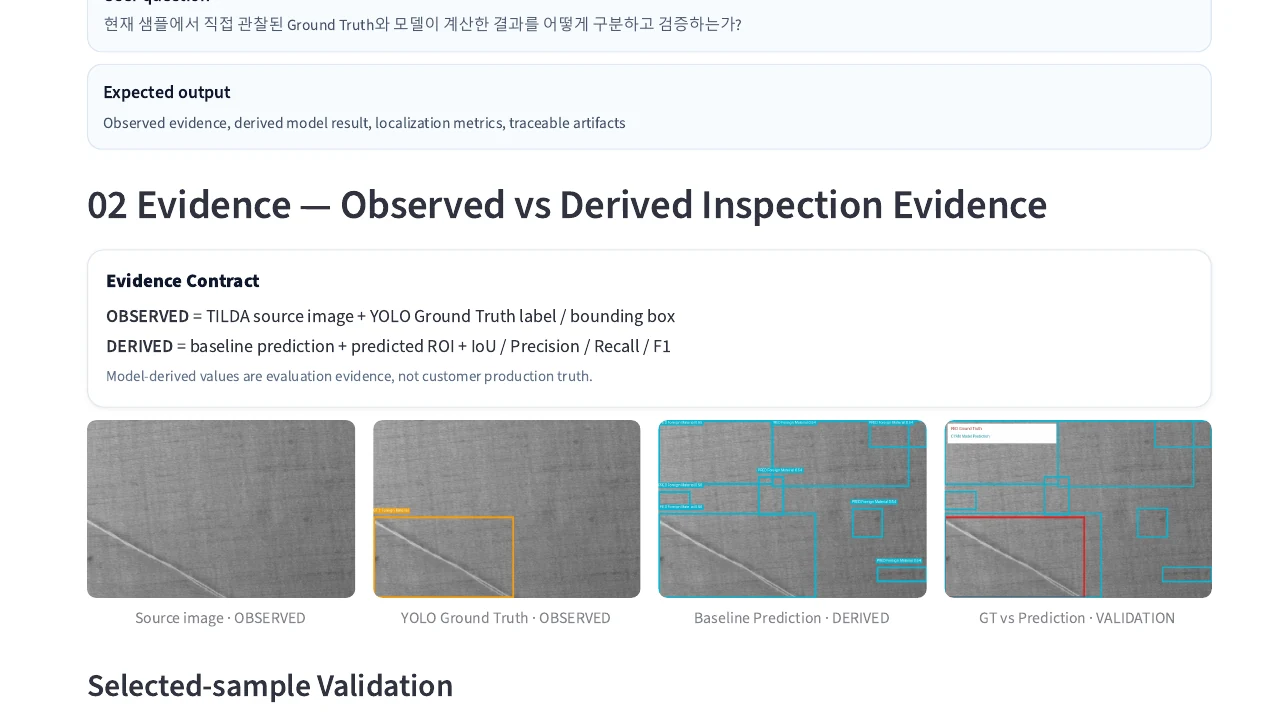
For enterprise AI, review answer evidence and citations. For Industrial AI, validate detection, cause, condition comparison, evidence traceability, and engineering KPIs under agreed conditions
Connect validated retrieval, knowledge-graph, and vision workflows to customer data and systems within a bounded scope. Validate Physics AI separately after customer data, boundary conditions, and reference CAE are available
Extend operations with reviewable quality, evidence, cost, KPIs, and traceability
From Enterprise GraphRAG and RAG Assessment to Vision AI and Thermal Engineering Knowledge Twin, we examine data, evidence, evaluation, and operating constraints before changing the model. We connect the current state to Assessment → PoC → Optimization → Deployment.
Assessment is the starting point. Semantic Graph turns findings into improvement priorities, focused PoC validation, and an executable path to production.