Semantic Graph Co., Ltd.
KR EN
Platform Use Cases & Demos Delivery Company Contact Us
INDUSTRIAL PHYSICAL AI FOR ADVANCED MANUFACTURING

Predict Physical Processes.Explain Engineering Decisions.

Industrial Physical AI for semiconductor and advanced manufacturing. Connect physical models with process data to predict faster and explain decisions with evidence.

  • PredictPhysics AI · Thermal Digital Twin
  • InspectAI Vision · SWIR · Sensor
  • ExplainKnowledge Graph · RCA · GraphRAG
Physics-Informed Thermal Digital Twin HBM · Advanced Packaging
STACKED DIE · MATERIAL · POWER · BOUNDARY
Hotspot Predict
Thermal R Estimate
Reliability Assess
On-premise deploymentOperate manufacturing data and knowledge in a secure private environment
Explainable RCATrace evidence across defects, lots, processes, equipment, and actions
Inspection integrationConnect AOI, SWIR, camera, and sensor data step by step
Implementation pathwayMove from technical assessment and demos to a deployment proposal
Product Evidence

How inspection results become engineering decisions

Semantic Graph moves beyond displaying detections by connecting manufacturing context, evidence, similar cases, and corrective-action history.

Explore Industry Demos
INSPECTION EVIDENCE
Lot F-2408-17Review
Defect classLow-contrast anomaly
Evidence linkedImage · Process · Material
Inspection readiness82%
TraceabilityEvidence attached
01 · INSPECT

Inspection Evidence Workspace

Review inspection images and decisions together with lot, material, and process-condition context.

ROOT-CAUSE GRAPH
DefectProcess
Step
Action
Top candidateDryer temperature drift
Supporting evidence4 linked records
02 · EXPLAIN

Evidence-grounded RCA

Review ranked root-cause candidates together with the manufacturing records that support each conclusion.

ENGINEERING ASSISTANT
Show similar low-contrast defect cases and corrective-action outcomes.
Three recent cases share process-temperature deviation and material-batch changes as common factors.
Case-021SOP-14Action-008
03 · IMPROVE

GraphRAG Process Intelligence

Support the next engineering decision with standards, historical defects, action records, and similar cases.

These are representative interface modules for explaining the product workflow. Detailed capabilities and customer-specific scenarios are provided after an implementation inquiry.

INSPECT · EXPLAIN · IMPROVE

Connect inspection evidence to root cause and process decisions

Go beyond viewing inspection results. Connect evidence → root cause → next action in one engineering workflow.

  • Link images, decisions, lots, materials, and process context
  • Review evidence-grounded RCA and similar cases
  • Support engineering actions with GraphRAG
Inspection Evidence
Lot F-2408-17Review
Defect classLow-contrast anomaly
Evidence linkedImage · Process · Material
Inspection readiness
82%
Linked evidence summary
▧Images24
⌘Process records8
△Material records6
▤Documents5
Sample evidence
+21 more
▣ Image▶⌘ Process▶◇ Material
01 · INSPECT

Inspection Evidence Workspace

Review inspection images and decisions together with lot, material, and process context in one evidence workspace.

Root-Cause Graph
★
Top candidate RCADryer temperature drift
Confidence0.78
DefectLow-contrast
Process StepDrying
ParameterTemperature
MaterialFilm substrate
ActionCalibrate sensor
0.780.820.680.650.710.56
Key drivers• Temperature variation ↑
• Drying time fluctuation
• Substrate lot variance
Supporting evidence• 4 linked records
• 3 similar cases
• 2 SOP references
02 · EXPLAIN

Evidence-grounded Root Cause Analysis (RCA)

Evaluate root-cause candidates together with linked manufacturing data, supporting evidence, and process context.

Engineering Assistant
Show similar low-contrast defect cases and the actions that worked.
Three similar cases indicate process-temperature drift and material-lot changes as recurring factors.
Likely causeDryer temperature drift
(±2.3°C+)
EvidenceSOP-14
Drying Control
Recommended actionCalibrate sensor and
reset drying conditions
Evidence references
Case-021SOP-14Action-008+2 more
Top similar cases
Case-021
0.91
Case-053
0.84
Case-077
0.76
Answer confidence
81%
03 · IMPROVE

GraphRAG Process Intelligence

Support the engineer’s next decision using standards, historical defects, corrective actions, and similar cases as evidence.

WHY SEMANTIC GRAPH

Connect manufacturing quality AI to real process decisions

We combine inspection intelligence with data security, explainable analysis, system integration, and a stepwise implementation pathway.

01

Manufacturing-focused design

Connect defects, lots, materials, processes, equipment, and actions around real engineering workflows.

02

Explainable analysis

Review root-cause candidates and recommended actions together with supporting evidence and similar cases.

03

On-premise deployment

Operate manufacturing data and knowledge securely within enterprise or private environments.

04

Existing-system integration

Connect AOI, SWIR, camera, sensor, and quality data through a phased approach.

05

Stepwise implementation

Reduce risk through inquiry review, technical assessment, data discussion, demos, and deployment planning.

06

Customer data security

Use anonymized public demos and conduct customer-specific assessment after NDA and security alignment.

FLAGSHIP PRODUCT · SEMICONDUCTOR FOCUS

Physics-Informed Thermal Digital Twin for Advanced Semiconductor Packaging

The flagship goal is simple: complement and accelerate repeated thermal analysis with Physics AI for HBM, chiplets, and advanced packaging.

  • Physics + DataPhysical laws · Boundary conditions · Thermal sensor data
  • Faster PredictionTemperature field · Hotspot · Thermal resistance
  • Model CalibrationContinuous correction with measured and sensor data
  • Engineering DecisionReliability risk · Design and process decision support
PROTOTYPE · EARLY PRODUCT DEVELOPMENT
SEMICONDUCTOR FOCUS

Thermal Digital Twin

Inputs
Geometry · Material properties · Power · Boundary conditions · Thermal sensor data

Predictions
Temperature field · Hotspot · Thermal resistance · Reliability risk

Current stage: prototype / early product development. The product is positioned to complement and accelerate repeated CAE workflows, not to claim wholesale replacement of high-fidelity simulation.

Thermal Digital Twin Workflow Physics + Data
Geometry Materials Power Process Sensors
Physics AI
Digital Twin
Temperature Field Hotspot Thermal Resistance Reliability Risk Optimization
Thermal Digital Twin · Prototype UI Preview
Physics + Data + Engineering Decision
Demo in Development

Model Inputs

Geometry / Stack Material Properties Power Map Boundary Conditions Thermal Sensor Data

Predicted Temperature Field

Engineering Outputs

Hotspot Prediction
Thermal Resistance Estimation
Reliability Risk Assessment
Model Calibration Sensor-guided
This is a product UI concept for the prototype under development. It will be replaced with measured-data and interactive workflow screens when the live demo is completed.
WHY THERMAL DIGITAL TWIN

Thermal engineering is becoming a critical differentiator for next-generation HBM

As HBM moves toward higher stacks and higher power density, Thermal Engineering is becoming a product-level KPI for performance, reliability, and package design.

01 · INDUSTRY TREND

Higher Stack · Higher Power Density

  • 12-layer+ stacking and higher power density
  • Thinner dies · Warpage · Interface materials
  • A multi-physics packaging problem, not just cooling
02 · THERMAL KPI

Thermal Resistance Becomes a Product KPI

  • Public example: ~17% lower thermal resistance
  • Dedicated heat-dissipation path example: ~30% reduction
  • Thermal performance joins bandwidth and capacity as a key KPI
03 · ENGINEERING CHALLENGE

More Design Variables, Faster Decisions

  • Geometry · Material · Power map
  • Boundary conditions · Package process · Sensor data
  • Need to explore a broader design space faster
04 · SEMANTIC GRAPH RESPONSE

Physics-Informed Thermal Digital Twin

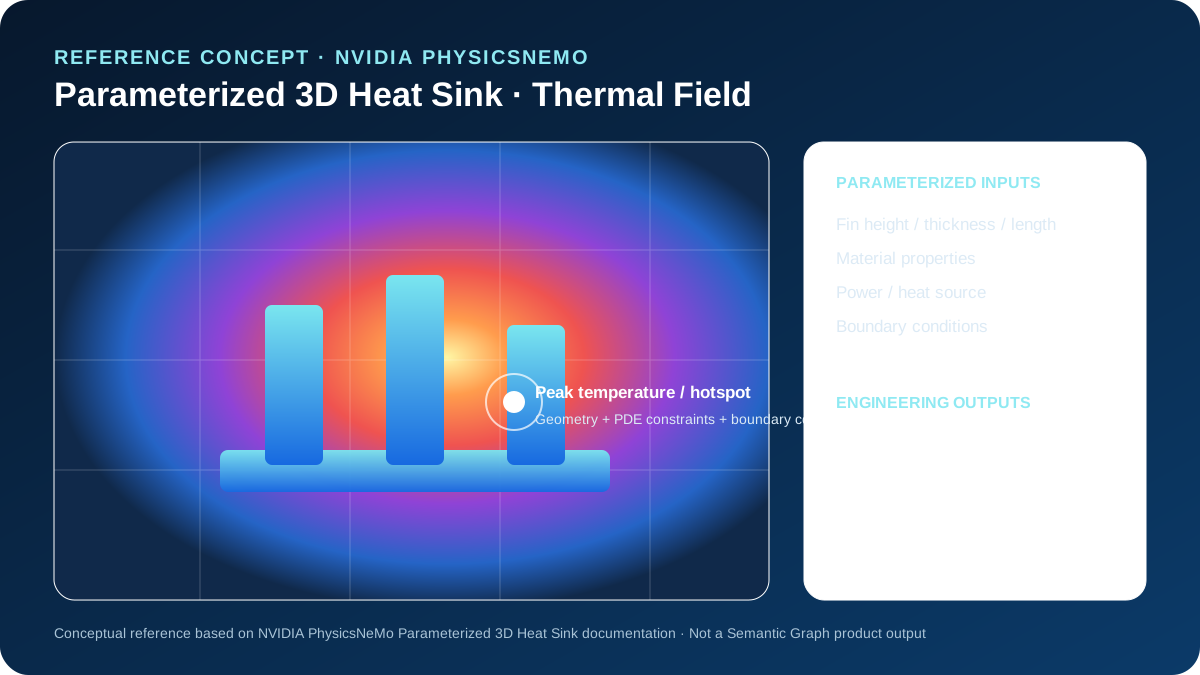
Thermal-field reference concept based on NVIDIA PhysicsNeMo Parameterized 3D Heat Sink example
Reference Concept · based on NVIDIA PhysicsNeMo Parameterized 3D Heat Sink · not a Semantic Graph product output. NVIDIA source ↗
  • Complement and accelerate CAE rather than replace it
  • PINN/Physics AI + sensor and measured data
  • Hotspot · Thermal resistance · Reliability risk
  • Extend toward design-optimization workflows

Background is based on publicly disclosed next-generation HBM packaging and thermal-management trends. Numerical examples are industry reference points, not performance claims for Semantic Graph's product.

NVIDIA TECHNOLOGY ROADMAP

Scaling productization with NVIDIA accelerated computing

NVIDIA GPU and CUDA remain core acceleration technologies, while PhysicsNeMo and Omniverse/OpenUSD are evaluated progressively. For field operations, we use an x86-based Physical AI Server as the primary platform; Jetson/TensorRT is applied selectively as an edge inference node after validating application, driver, and NVIDIA SDK compatibility.

PLANNED EVALUATION

PhysicsNeMo

Physics-informed and surrogate modeling for thermal and process behavior.

DEVELOPMENT

NVIDIA GPU · CUDA

Model training, accelerated inference, and industrial AI workloads.

ROADMAP

Omniverse · OpenUSD

Geometry, simulation data, and manufacturing digital twin foundation.

SELECTIVE EDGE

Jetson · TensorRT

Applied selectively for low-latency edge inference after validating ARM/JetPack application compatibility and NVIDIA SDK dependencies.

Semantic Graph is applying to NVIDIA Inception. NVIDIA Inception membership is not claimed on this website.

PHYSICAL AI SERVER & EDGE INFRASTRUCTURE

Industrial AI Edge Server first, with field inference where it adds value

For enterprise operations, external services, maintainability, and software compatibility, we use x86_64 servers/workstations as the primary Physical AI operating platform. NVIDIA Jetson is reserved for validated low-latency edge inference close to equipment, with ARM/JetPack and SDK constraints reviewed in advance.

PRIMARY PLATFORMx86_64 Physical AI ServerGPU · GraphRAG · Digital Twin · API
ACCELERATIONNVIDIA GPU · CUDATraining · Inference · Physics AI
SELECTIVE EDGEJetson Orin · TensorRTValidated Camera/Sensor Inference
PRIMARY · PHYSICAL AI SERVER

x86 GPU Server / Workstation

We design x86_64 Linux/Windows servers as the default operating platform for software compatibility, security, maintainability, and external-service integration.

  • Physics AI · GraphRAG · Digital Twin
  • API · MES/QMS/ERP integration
  • On-Prem · Private Environment
SELECTIVE · EDGE INFERENCE

NVIDIA Jetson Orin Node

Jetson is applied after validating ARM-based JetPack/Ubuntu application and driver compatibility, primarily for NVIDIA-SDK-centric low-latency inference close to cameras and sensors.

  • Industrial Camera · Sensor
  • TensorRT · NVIDIA SDK
  • Low-latency field inference
INDUSTRIAL INTEGRATION

Vision · Sensor · Edge-to-Server

We connect industrial cameras, SWIR/thermal sensors, equipment I/O, storage, and networking to the x86 Physical AI Server and validated edge nodes.

  • Camera / Sensor / I/O
  • Storage · Network
  • Edge-to-Server Architecture

Deployment principle. Jetson is not positioned as a universal server replacement. We first validate the customer's software stack and operating requirements, use x86 Physical AI Servers as the default platform, and add Jetson only where the NVIDIA ecosystem and edge workload are a clear fit. Hardware sourcing and integration do not imply NVIDIA-authorized distributor or reseller status.

PHYSICAL AI ECOSYSTEMThrough activities related to the Korea AI Software Industry Association (KOSA) Physical AI Alliance 2.0, Semantic Graph is strengthening an industrial Physical AI architecture that connects AI models, semiconductors, sensors, and computing infrastructure.
APPLICATIONS & DEMOS

Semiconductor Physical AI applications backed by completed manufacturing AI demos

Physics-Informed Thermal Digital Twin is being developed as our strategic flagship product, while completed SWIR, TILDA400, and Film demos demonstrate our manufacturing AI development and execution capability.

01 Flagship · In Development

Physics-Informed Thermal Digital Twin

PhysicsNeMo-based reference concept for the Physics-Informed Thermal Digital Twin
Reference Concept · based on NVIDIA PhysicsNeMo · Semantic Graph Thermal Twin demo in development

For HBM, chiplet, and advanced packaging, the Thermal Digital Twin combines geometry, material properties, power, boundary conditions, and thermal sensor data with physical laws and PINN/Physics AI surrogate models to predict temperature fields, hotspots, thermal resistance, and reliability risk. It is designed to complement and accelerate high-fidelity CAE.

Engineering Challenge Hotspot · Thermal Resistance · Reliability
Core Technology PINN · Physics AI · Digital Twin
Demo in Development Contact Us
02 Completed · MVP

SWIR Defect Inspection Intelligence

Actual SWIR Defect Inspection Intelligence demo screen
Actual Demo Screen · SWIR inspection evidence & detection overlay

A completed demo using SWIR (Short-Wave Infrared) imaging to detect low-contrast and internal anomaly signals that are difficult to identify with visible-light inspection, then connect them with defect, lot, equipment, and process context for quality decisions, root-cause analysis, and GraphRAG.

Engineering Challenge Low Contrast · Internal Anomaly · Process Signals
Core Technology SWIR · RCA · GraphRAG
03 Completed · Demo

TILDA400 Quality Intelligence

Actual TILDA400 Quality Intelligence demo screen
Actual Demo Screen · Ground Truth vs Baseline Prediction

A manufacturing quality-intelligence demo using TILDA400 surface-defect data to connect defect-detection results with lot, process, cause, and corrective-action context, validating a workflow from inspection automation to explainable RCA and engineering action.

Engineering Challenge Surface Defect · Lot · Process · Corrective Action
Core Technology AI Vision · Quality Graph · RCA
04 Completed · PoC-ready

Film Surface Inspection

Film Surface Inspection original image, defect overlay, and anomaly mask results
Inspection Output · Original · Defect Overlay · Anomaly Mask

A completed AI vision inspection demo that detects and classifies scratches, foreign materials, stains, bubbles, wrinkles, and other surface defects in film, coating, and continuous web materials, then links defect location and type with lot and process context for quality root-cause analysis.

Engineering Challenge Scratch · Foreign Material · Stain · Bubble · Wrinkle
Core Technology AI Vision · Traceability · RCA

SWIR, TILDA400, and Film images are taken from actual Semantic Graph demo/prototype screens. Public demos use anonymized sample or synthetic data, and customer performance is validated separately with customer data and inspection criteria. The Thermal Digital Twin image is a reference concept based on a public NVIDIA PhysicsNeMo example, not a Semantic Graph product output.

PROOF & TRACTION

Clear development stages and validation milestones

Even when customer names remain confidential, transparent product and demo stages provide strong evidence of execution capability.

SEMICONDUCTOR · PHYSICS AI

Thermal Digital Twin

Productizing HBM thermal modeling through a Physics AI prototype pathway.

Proposal / Prototype
SEMICONDUCTOR · SWIR

SWIR Defect Intelligence

Implemented low-contrast/internal anomaly detection with an RCA/GraphRAG workflow.

Completed MVP
TEXTILE · TILDA400

TILDA400 Quality Intelligence

Validated a quality-intelligence workflow from surface-defect detection to engineering action.

Completed Demo
FILM & COATING

Film Surface Inspection

Built a film surface-inspection prototype with result drilldown.

PoC-ready
PHYSICS AI RESEARCH & COLLABORATION

Applying PINN-based Physics AI to semiconductor engineering

PINNs (Physics-Informed Neural Networks) incorporate physical laws and boundary conditions into the learning process. We move Scientific ML beyond paper reproduction to build HBM Thermal Digital Twins and industrially validated prototypes.

PINNs · Scientific ML · Brown University · NVIDIA DLI
ACADEMIC COLLABORATION

From PINNs to Industrial Digital Twins

  • Academic Physics AIGeorge E. Karniadakis · Brown University · PINNs · Scientific ML
  • NVIDIA Accelerated ComputingDLI Science & Engineering Teaching Kit · GPU · PhysicsNeMo evaluation
  • Industry TranslationHBM Thermal Modeling · Advanced Packaging · Industrial Prototype
Current status: collaboration discussion / exploration. This does not represent an executed joint-research agreement with Professor George E. Karniadakis or Brown University, nor does it claim a separate formal partnership with NVIDIA Deep Learning Institute (DLI) or NVIDIA Inception.
RESEARCH-TO-INDUSTRY PIPELINE Academic Physics AI → NVIDIA Accelerated Computing → HBM Thermal Application → Industrial Validation
∿
01 · Academic Physics AI Scientific ML foundation George E. Karniadakis · Brown University · PINNs · Scientific Machine Learning
→
▣
02 · NVIDIA Accelerated Computing GPU-based engineering computing NVIDIA DLI Science and Engineering Teaching Kit · GPU · CUDA · PhysicsNeMo evaluation
→
◫
03 · HBM Thermal Application Semiconductor engineering use case HBM Thermal Digital Twin · Advanced Packaging · Hotspot Prediction · Thermal Resistance
→
✓
04 · Industrial Validation Prototype to deployment path Prototype · PoC · On-premise Productization · Engineering Workflow Validation
IP & PATENT ROADMAP · PRELIMINARY

Three priority Physical AI patent themes

The homepage summarizes the strategic themes. Detailed prior-art, novelty, and FTO considerations are moved to the Technology page.

PRIORITY 1

Adaptive Physics-Informed Thermal Digital Twin for HBM Packaging

Continuously calibrates an HBM thermal model by combining geometry, material, power, sensor data, and Physics AI residuals.

PRIORITY 2

Physics-Evidence Graph for Explainable Defect RCA

Connects inspection/process evidence with physics inconsistency to generate explainable root-cause paths.

PRIORITY 3

Closed-Loop Physical AI Process Optimization

Uses a Physics AI twin to validate AI-agent process actions before engineer-approved execution.

This is a preliminary roadmap and does not represent granted or filed patents. Novelty, inventive step, and FTO require separate professional review before filing.

PRODUCT ADOPTION PATH

From focused PoC to on-premise product deployment

We aim to enter through a measurable technical PoC, transition validated capabilities into repeatable product licenses, deploy on-premise, and expand across lines and plants.

01

Technical Fit

Define the process problem, data, and measurable KPI.

02

Focused PoC

Validate the core use case within a controlled scope.

03

Product License

Transition validated functions into repeatable product modules.

04

On-Prem Deployment

Deploy x86 Physical AI Servers as the primary operating platform and connect validated Jetson edge nodes only where low-latency field inference is required.

05

Enterprise Expansion

Scale Physical AI across processes, equipment, and lines.

ABOUT SEMANTIC GRAPH

Building an Industrial Physical AI product company

Since 2022, Semantic Graph has built manufacturing AI capabilities across vision, Knowledge Graph, and GraphRAG, and is expanding its core product focus into Physics AI and semiconductor Thermal Digital Twins.

Semantic Graph Industrial Physical AI Platform

  • Physics AI & Thermal Digital Twin
  • Industrial Vision · SWIR · Sensors
  • Knowledge Graph & Explainable RCA
  • GraphRAG & Engineering AI Agent
  • On-premise Enterprise AI
  • x86 Physical AI Server · Selective Jetson Edge Nodes
COLLABORATION & DELIVERY CAPABILITY

Connecting industrial operations, public programs, and technology partners

Semantic Graph delivers manufacturing AI through a stepwise pathway from public demos and customer-data PoCs to on-premise deployment and enterprise-system integration.

MANUFACTURING PoC

Semiconductor, film, hygiene, and mobility

We translate Film AOI, low-contrast SWIR intelligence, manufacturing RCA, and industry-specific quality scenarios into customer-data PoCs.

PUBLIC & INDUSTRY PROGRAMS

Industrial AX & Physical AI Ecosystem

Activities include KOIIA mid-market AX diagnostics and engagement around the Korea AI Software Industry Association (KOSA) Physical AI Alliance 2.0, supporting broader manufacturing Physical AI adoption and collaboration.

ENTERPRISE KNOWLEDGE AI

MOTIE Tech-GPT and manufacturing AX

We have worked on industrial paper and patent RAG as well as manufacturing ERP and CRM integration PoCs that connect documents, business data, and operational events.

PARTNER ECOSYSTEM

Optics, GPU infrastructure, and AI education

Our delivery ecosystem includes SWIR optical-inspection specialists, on-premise GPU infrastructure partners, NVIDIA Teaching Kits, and university and industry experts.

Customer names, equipment identifiers, and production information are not disclosed without prior approval. Public website content focuses on approved programs, anonymized technical cases, and delivery capabilities.
CONTACT

Tell us about your manufacturing AI initiative

Share these four items and we can quickly assess technical fit and the next step.

  • Current process or quality challenge
  • Available inspection / sensor data
  • Target KPI / validation criteria
  • Preferred environment and timing
Email
mkhwang@semanticgraph.io
Response Time
We review and respond within one to two business days.
Collaboration Areas
Physics AI · Thermal Digital Twin · AI Vision · x86 Physical AI Server · Edge AI · GraphRAG

When useful, we follow up with a focused data review or a 30-minute technical discussion.

01
Inquiry reviewReview your target solution and current quality or process challenge.
02
Technical discussionDiscuss inspection systems, data types, and deployment environment.
03
Feasibility assessmentAssess data integration, security conditions, and implementation scope.
04
Demo or proposalRecommend a tailored demo or phased implementation plan.
Response within 1–2 business daysNDA and security alignmentOn-premise deployment support

Your inquiry is submitted securely. If web submission is temporarily unavailable, we will open your email application as a fallback.